
How Annual Ceramic Coating Refreshes Can Save Fiberglass Trailer Owners Time and Money

Fiberglass travel trailers are built for years of adventure, but their exterior gel coat is constantly exposed to sunlight, weather, bugs, road grime, black streaks, minerals, and repeated washing.
A ceramic coating adds a protective layer over that gel coat and can make routine maintenance much easier. But ceramic coating still requires proper care and periodic attention to continue performing as intended.
An annual ceramic coating refresh gives owners an opportunity to inspect and renew that protection before washing becomes more difficult or oxidation has a chance to become established. When the surface is still in good condition, maintaining it is generally easier and less involved than correcting neglected gel coat later.
A refresh may also help reduce long-term maintenance time and expense. However, every trailer is different. Results depend on the trailer’s existing condition, storage environment, UV exposure, travel schedule, climate, and washing habits.

What Is an Annual Ceramic Coating Refresh?
An annual coating refresh is a preventive service designed to evaluate the existing protection and renew it as needed.
It is different from applying a quick maintenance spray, and it is not the same as restoring heavily oxidized fiberglass.
Depending on the condition of the trailer, an annual service may include:
Cleaning and inspecting the exterior
Evaluating coating and performance
Removing bonded contamination
Polishing the surface as appropriate
Preparing the surface for proper coating adhesion
Reapplying ceramic coating
Documenting the trailer’s condition and service history
The exact process should be based on the individual trailer. A trailer stored indoors and used occasionally may need something different from one stored outside in intense sunlight or driven thousands of miles each year.
That condition-based approach is important.
Refreshing a healthy, coated surface is one type of service. Correcting dullness, oxidation, and years of accumulated contamination is another.
How a Refresh Can Make Washing Easier
One of the most noticeable benefits of a well-maintained ceramic coating is easier routine cleaning.
A coated surface is designed to make bugs, dirt, road film, black streaks, and other common travel contamination less likely to cling stubbornly to the gel coat. When the coating is clean and performing properly, much of that buildup may release with less effort during a careful hand wash.
Refreshing the coating may help owners spend less time scrubbing and make the washing process more predictable. It can also reduce the temptation to reach for aggressive chemicals when ordinary dirt becomes difficult to remove.
Potential benefits include:
Less effort when removing common travel contamination
More manageable cleaning after long trips
Reduced need for repeated or aggressive scrubbing
A cleaner, glossier appearance between services
Less temptation to use harsh products that could damage the coating
Ceramic coating does not make a trailer self-cleaning, however. Bugs, mineral deposits, black streaks, and road grime still need to be removed.
Regular washing remains an important part of maintaining the coating and the trailer underneath it.

Why the Gel Coat Needs Consistent Protection
The shiny exterior finish on a molded-fiberglass trailer comes from its gel coat. In addition to giving the trailer its appearance, the gel coat helps protect the underlying fiberglass.
Unfortunately, UV exposure gradually breaks down that surface.
Early deterioration may appear as:
Reduced gloss
A slightly chalky texture
Yellowing or fading
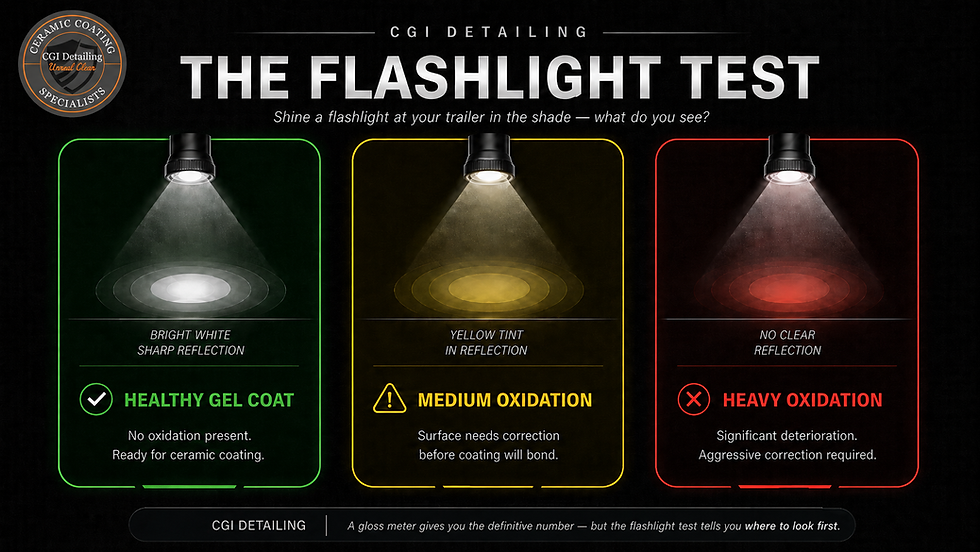
Inconsistent reflections
A surface that becomes increasingly difficult to clean
Once oxidation begins, it can progress quickly, particularly on trailers stored outside or exposed to strong southern sunlight. You should not assume that the surface will decline slowly or predictably.
As deterioration continues, restoring the finish may require additional compounding and polishing before a new coating can be applied.
Older or deeply weathered gel coat can also have restoration limits. In severe cases, polishing may not return the surface to its original appearance.
A ceramic coating creates a sacrificial protective layer over the gel coat. It cannot stop every form of aging, eliminate all maintenance, or reverse existing damage. It can, however, help reduce direct environmental exposure and make the exterior easier to care for.
An annual inspection also gives a technician an opportunity to identify changes before they become more involved.

Preventive Maintenance vs. Waiting for Correction
The main advantage of annual coating maintenance is consistency.
When a trailer returns while the surface and coating are still in good condition, the service may focus on cleaning, inspection, light polishing, surface preparation, and renewed protection.
When protection has been allowed to decline and oxidation has become established, the process can become more involved. Additional compounding and polishing may be necessary before the surface is ready for coating again.
More extensive correction can mean:
More time spent preparing the trailer
Heavier correction and more steps used during polishing
Heavier Oxidation can lead to more expensive corrective maintenance
This is why preventive care can sometimes save owners both time and money. A planned refresh may be easier to schedule and manage than a larger restoration project.
Those savings are potential benefits rather than guarantees. No coating or maintenance schedule can guarantee that correction will never be necessary.
The outcome depends on the trailer’s age, previous care, current condition, climate, storage, travel, and washing routine.
Which Trailers May Benefit Most From Annual Refreshes?
Every coated fiberglass trailer can benefit from periodic evaluation. An annual refresh may be especially useful when the trailer:
Is stored outdoors for most or all of the year
Regularly travels through areas with strong UV exposure
Is used frequently or driven long distances
Encounters coastal air, road salt, bugs, or heavy road film
Has become less slick or more difficult to wash
Shows weaker water behavior than it did previously
Has dull areas, fading, yellowing, or a chalky texture
Has gone for extended periods without appropriate washing
Has an uncertain coating or maintenance history
Calendar timing is only a starting point. Two trailers of the same age can have very different maintenance needs.
For example, an indoor-stored trailer used for a few seasonal trips will experience very different conditions from a full-time travel trailer stored outdoors in Florida or Texas.
A professional inspection can help determine whether the coating needs a full refresh, lighter maintenance, or corrective work.
What Should Owners Do Between Annual Services?
An annual visit works best when it is supported by proper care throughout the year.
Wash the trailer regularly
CGI Detailing recommends washing coated trailers at least monthly, with additional washing when travel or environmental exposure makes it necessary.
Bugs, road film, salt, bird droppings, and minerals should not be allowed to remain on the surface unnecessarily.
Use ceramic-safe cleaning products
Dish soap, strong degreasers, and other aggressive cleaners can reduce coating performance.
Use products designed for ceramic-coated fiberglass surfaces and follow the manufacturer’s directions.
Dry the exterior after washing
Allowing hard water to dry on the trailer can leave behind mineral deposits and water spots. Drying the surface after washing can help prevent those deposits from becoming more difficult to remove.
Apply the recommended maintenance booster
A ceramic-safe maintenance spray can help support coating performance between professional services.
CGI Detailing recommends applying its Ceramic Shield booster according to the maintenance schedule provided for the trailer.
Pay attention to changes
A trailer that suddenly becomes harder to clean may be signaling that the coating is contaminated or beginning to decline.
Other warning signs include:
Fading gloss
Chalkiness
Reduced slickness
Yellowing
Inconsistent water behavior
These changes should be evaluated rather than addressed with increasingly aggressive scrubbing or stronger chemicals.
Does a Refresh Mean the Original Coating Failed?
Not necessarily.
An annual refresh is preventive maintenance. Its purpose is to inspect and renew protection before performance declines far enough to create additional risk for the gel coat.
Coating performance can change because of environmental exposure, contamination, washing products, storage conditions, and maintenance habits.
Refreshing the coating on a planned schedule helps account for those variables and gives the trailer an opportunity to be professionally evaluated on a regular basis.
Can a Refresh Repair Oxidation?
A refresh and an oxidation correction are not the same service.
Light surface decline may be improved during cleaning and polishing. Established oxidation, however, can require dedicated correction before the trailer is ready for coating.
The severity and depth of oxidation both matter. Two trailers can appear similarly dull while requiring very different levels of work because of their age, exposure, and maintenance history.
Severely neglected or deeply weathered gel coat may also have limits to how much it can be improved through polishing.
That is another reason to address declining protection early rather than waiting until the exterior has noticeably deteriorated.
Will Ceramic Coating Eliminate Maintenance?
No.
Ceramic coating simplifies maintenance; it does not eliminate it.
A properly maintained coating may help dirt release more easily and reduce the effort required during routine washing. Owners must still remove contaminants, use appropriate products, dry the trailer, and monitor the exterior.
Owners who prefer professional support can use a maintenance-plan service to keep inspections, polishing, coating refreshes, and service records on a consistent schedule.
This can be particularly helpful for people who travel frequently, store their trailers outside, or simply do not want to manage every part of the coating-maintenance routine themselves.
Consistent Care Can Help Prevent a Bigger Project
The value of an annual ceramic coating refresh is not necessarily a dramatic transformation.
Its value is consistency.
Keeping the protection active may make washing more manageable, help preserve the gel coat, and reduce the likelihood that the trailer will need more involved correction later.
For many fiberglass trailer owners, a planned annual visit is easier than waiting until obvious dullness or oxidation signals that the exterior needs attention.
The results will always depend on the individual trailer. Exposure, storage, climate, travel, washing habits, and existing condition all influence how the coating and gel coat perform.

Is Your Trailer Ready for a Ceramic Coating Refresh?
Not sure what condition your coating is in?
CGI Detailing can help evaluate your trailer’s current condition and determine whether an annual refresh, corrective service, or Ceramic Shield Maintenance Plan service makes the most sense.
To get started, share your trailer’s year, model, location, storage conditions, and a few photos of the exterior.
Visit cgidetailing.com, call 615-900-0648, or email cgi@cgidetailing.com to start the conversation.

Comments