
What Is Oxidation and What Can It Do to Your Trailer?

What is Oxidation
If your fiberglass travel trailer used to look bright and glossy but now looks dull, cloudy, faded, or chalky, you are probably looking at oxidation. On fiberglass trailers, oxidation is more than a cosmetic issue. It is a sign that the outer gel coat surface is being broken down by sunlight, oxygen, moisture, heat, road grime, and time.
That matters because the gel coat is the trailer's visible protective skin. It gives fiberglass trailers their shine, color, smoothness, and weather resistance. When oxidation starts, the surface becomes rougher and more porous. Dirt sticks more easily. Black streaks become harder to wash off. The trailer may still be structurally sound, but the surface is no longer protecting itself the way it should.
At CGI Detailing, we see this most often on molded fiberglass travel trailers such as Oliver, Escape, Bigfoot, Casita, and Scamp trailers. These trailers are built to last, but their gel coat still needs care. Oxidation can usually be corrected, but the longer it sits, the more work it takes to remove and the more important long-term protection becomes.

Quick answer Oxidation is the dull, chalky surface damage that happens when fiberglass gel coat reacts with UV exposure, oxygen, moisture, and environmental contamination. It can make your trailer harder to wash, reduce gloss, deepen staining, and eventually require aggressive correction. Ceramic coating does not remove existing oxidation, but after the oxidation is corrected, it helps protect the restored gel coat and slow the conditions that cause oxidation to return. |
What Is Gel Coat Oxidation?
Most molded fiberglass trailers are finished with gel coat, not automotive clear coat. Gel coat is a pigmented resin layer that forms the exterior surface of the fiberglass shell. When it is healthy, it looks smooth and glossy because light reflects evenly off the surface.
Oxidation starts when that surface is exposed to sunlight and oxygen over time. UV radiation is especially important because it breaks down the surface of the resin. As the outer layer degrades, the surface becomes dull, cloudy, faded, and chalky. Marine restoration sources describe oxidized gel coat as a reaction with sunlight and oxygen that changes a shiny surface into a dull one. Yachting Magazine also notes that UV exposure causes gel coat to become faded and dull as chalky oxidation fills microscopic pores and cracks.
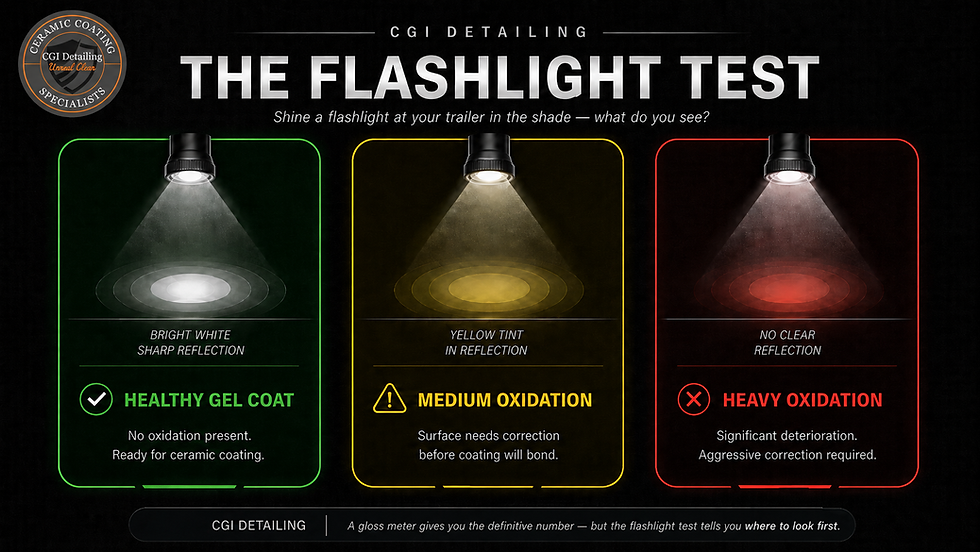
That chalk you can sometimes wipe onto your hand is not just dirt. It is degraded surface material. A lightly oxidized trailer may look slightly hazy. A moderately oxidized trailer may look flat and cloudy. A severely oxidized trailer may feel rough, leave white residue on your fingers, and lose most of its reflection.
Why Fiberglass Trailers Oxidize
Oxidation is not usually caused by one bad wash or one season of use. It is cumulative exposure. A trailer that lives outside sees UV rays, humidity, rain, road film, bugs, tree sap, minerals, airborne pollutants, and repeated heat cycles. Over months and years, those conditions wear down the gel coat surface.
The most common causes include:
Sun and UV exposure: The biggest driver. Trailers stored outside in direct sun oxidize faster than trailers stored indoors or under cover.
Oxygen and moisture: Oxidation is a surface reaction, and moisture can help contaminants stay in contact with the gel coat.
Road grime and organic contamination: Bugs, sap, bird droppings, black streaks, and industrial fallout can bond more aggressively as the surface becomes porous.
Loss of protection: Wax, sealant, or coating eventually wears down. Once the gel coat is exposed, oxidation accelerates.
Improper cleaning: Harsh cleaners, abrasive scrubbing, and neglect can make the surface rougher and easier for contamination to grab.
What Oxidation Does If You Ignore It
Early oxidation is easy to underestimate because the trailer may simply look a little less glossy than it used to. The problem is that oxidation tends to feed on itself. As the surface loses gloss and smoothness, it holds more contamination. As contamination sits longer, washing becomes harder. As washing becomes harder, owners may scrub more aggressively or use stronger chemicals, which can make the finish worse.
Here is what can happen if oxidation is left untreated.
1. The Trailer Loses Gloss and Reflectivity
Gloss is not just about looks. A glossy gel coat is smoother and reflects light more evenly. When oxidation breaks down the surface, that reflection becomes scattered. The trailer looks cloudy, flat, or chalky instead of crisp and bright.
2. The Surface Becomes More Porous
Oxidized gel coat is rougher at a microscopic level. That roughness gives dirt, minerals, bugs, and black streak residue more places to sit. This is why an oxidized trailer can look dirty again shortly after washing. The surface is not releasing contamination cleanly.
3. Black Streaks and Stains Become Harder to Remove
Fiberglass trailer owners know black streaks well. They often come from dirty rainwater running off roof edges, window seals, awnings, vents, and trim. On a protected, slick surface, those streaks are usually easier to wash away. On oxidized gel coat, they can bond into the porous surface and require stronger cleaning or correction.
4. Maintenance Gets More Labor-Intensive
A healthy, protected trailer should wash reasonably well with the right soap and technique. An oxidized trailer often requires repeat passes, stronger cleaners, or mechanical polishing. That means more time, more product, and more risk of damaging decals, trim, and thin gel coat areas.
5. Restoration Becomes More Aggressive
The longer oxidation sits, the more damaged material must be removed to get back to a clear, glossy surface. 3M's heavy oxidation process for gel coat can include cleaning, optional sanding, buffing with heavy cutting compound, polishing, and protection. In other words, severe oxidation is not fixed by simply wiping on a shiny product.
Can Oxidation Damage the Trailer Structurally?
Most surface oxidation is a gel coat problem, not an immediate structural problem. But ignoring oxidation is still a bad long-term strategy because gel coat is the exterior protective surface. Once that surface is degraded, the trailer is more vulnerable to staining, water spotting, contaminant bonding, and repeated abrasive correction.
The practical risk is that you slowly spend down the trailer's finish. Every heavy correction removes a small amount of material. That is why prevention matters. It is better to correct oxidation once, refine the surface properly, and protect it than to repeatedly chase chalkiness after it returns.

How Oxidation Is Removed
Oxidation removal is the process of removing the damaged surface layer, refining the finish, and protecting the corrected gel coat. The right process depends on how severe the oxidation is.
Wash and decontaminate the trailer. The surface needs to be clean before polishing. Bugs, sap, road tar, black streak residue, and mineral deposits should be removed so they are not dragged across the gel coat during correction.
Evaluate the oxidation level. Light haze may respond to a mild polish. Moderate oxidation may need a stronger compound. Severe chalking may require heavy compounding and, in some cases, controlled sanding before buffing.
Compound to remove damaged material. Professional gel coat compounds are designed to cut oxidation, weathering, dullness, scratches, and surface blemishes. 3M describes its heavy cutting gel coat compound as suitable for gel coat surfaces including marine, RV, and industrial use.
Polish to refine gloss. Cutting removes oxidation, but it can leave haze or micro-marring. A polishing step refines the surface, so the trailer looks glossy rather than merely less chalky.
Wipe down and prepare for protection. Before ceramic coating, the surface should be free of polishing oils and residue so the coating can bond properly.
Protect the restored surface. This is where wax, sealant, or ceramic coating comes in. Without protection, oxidation can return quickly because the corrected gel coat is exposed again.
At CGI Detailing, oxidation removal is treated as a correction process, not a cover-up. For fiberglass travel trailers, the goal is to safely restore gloss while preserving as much gel coat as possible. That can mean a multi-stage approach using rotary and dual-action polishers, cutting pads, finishing pads, and coating prep before long-term protection is applied.
Why Ceramic Coating Matters After Oxidation Removal
Ceramic coating is important because oxidation removal solves the existing damage, while coating helps protect the corrected surface. The distinction matters: a ceramic coating cannot restore oxidized gel coat by itself. If the trailer is already chalky, coating over the oxidation would trap a dull, damaged surface under a protective layer. The right order is correction first, coating second.
Once the gel coat has been corrected and properly prepped, a professional ceramic coating gives the trailer a more durable protective barrier than traditional wax. Marine ceramic coating sources generally describe the benefits in terms of reduced exposure to UV, moisture, and contaminants, plus a hydrophobic surface that helps water bead and release more easily. A coating will not stop oxidation forever, but it can significantly slow the conditions that make oxidation return.
How Ceramic Coating Helps with Oxidation
UV resistance: Sun exposure is one of the biggest causes of oxidation. A quality marine-grade ceramic coating helps reduce direct UV stress on the gel coat.
Hydrophobic behavior: Water beads and sheets off more easily, which helps reduce moisture retention, mineral deposits, and water spotting.
Reduced contaminant bonding: Bugs, grime, sap, and black streak residue have a harder time sticking to a slick coated surface.
Easier washing: Because the surface releases dirt more easily, routine maintenance is less aggressive and less time-consuming.
Gloss preservation: Coating helps preserve the corrected finish so the trailer stays brighter longer after restoration.
CGI Detailing service note CGI Detailing offers professional ceramic coating for fiberglass travel trailers. For oxidized trailers, coating should come after oxidation removal, polishing, and coating prep. For new or well-maintained trailers, coating early can help preserve the original gel coat before heavy oxidation sets in. |
Ceramic Coating vs. Wax for Oxidation Protection
Wax can help, but it is temporary. Traditional wax adds gloss and short-term protection, and it is still better than leaving gel coat bare. The challenge is that fiberglass trailers often sit outside for long periods, and wax breaks down under sun, rain, washing, and road exposure.
Ceramic coating is a longer-term protection strategy. It bonds to the prepared surface and creates a harder, slicker, more durable barrier. For owners who want the easiest maintenance and the best chance of preserving restored gloss, ceramic coating is usually the stronger option after proper correction.
That does not mean coating is magic. A coated trailer still needs to be washed correctly. It should not be scrubbed with harsh abrasives. Water spots should not be allowed to bake on the surface indefinitely. But compared with an unprotected or lightly waxed oxidized trailer, a properly coated fiberglass trailer is much easier to maintain.
When Should You Fix Oxidation?
The best time to address oxidation is when it is still light. If your trailer is beginning to look hazy, feels less slick after washing, or no longer beads water, it is time to inspect the finish. Waiting until the surface is heavily chalked usually means more labor, more aggressive correction, and more cost.
You should consider professional oxidation removal if:
Your hand or towel picks up chalky residue from the trailer.
The trailer looks dull even after washing.
Black streaks or bug residue are becoming difficult to remove.
The gel coat feels rough, dry, or porous.
You want to ceramic coat the trailer, but the surface is not glossy and clean enough for coating.
Can You Remove Oxidation Yourself?
Light oxidation can sometimes be improved by an experienced owner with the right gel coat-safe products, pads, and patience. But moderate to heavy oxidation is easy to underestimate. The work is slow, physically demanding, and technique sensitive. Too much pressure, too much heat, the wrong pad, or the wrong compound can create haze, swirl marks, uneven gloss, or damage around decals and edges.
The bigger issue is incomplete correction. If oxidation is only partially removed and then covered with wax or coating, the trailer may look better for a short time but fade quickly. Professional correction is about fully removing the failed surface layer, refining the finish, and protecting it so the result lasts.
How to Prevent Oxidation from Coming Back
Once your trailer has been corrected, prevention becomes the priority.
Wash regularly with a safe soap and soft wash media.
Remove bugs, sap, bird droppings, and black streaks before they bond deeply.
Avoid harsh household cleaners and abrasive scrub pads.
Store indoors, under cover, or in shade when possible.
Keep a durable layer of protection on the gel coat.
Consider ceramic coating if you want longer-term protection and easier washing.
For many fiberglass trailer owners, ceramic coating is the best fit because it supports the way these trailers are actually used. They travel, sit in sun, get covered in bugs, collect black streaks, and spend long stretches outdoors. A coating helps the finish resist that cycle and makes routine washing more manageable.
The Takeaway
Oxidation is what happens when your fiberglass trailer's gel coat starts to break down from sun, oxygen, moisture, and environmental exposure. At first, it may look like simple dullness. Over time, it can become chalky, porous, harder to wash, more prone to staining, and more labor-intensive to restore.
The fix is not to hide oxidation. The fix is to remove it carefully, polish the gel coat back to clarity, and protect the restored surface. Ceramic coating plays a major role in that protection. It does not reverse oxidation on its own, but when applied after proper correction, it helps preserve gloss, improve washability, reduce contaminant bonding, and slow the return of oxidation.
If your Oliver, Escape, Bigfoot, Casita, Scamp, or other fiberglass travel trailer is starting to look dull or chalky, do not wait for the finish to get worse. Restoring it sooner usually means better results, less aggressive correction, and a cleaner path to long-term ceramic protection.
FAQ
What does oxidation look like on a fiberglass trailer?
Oxidation usually looks dull, hazy, faded, cloudy, or chalky. In heavier cases, the surface may feel rough and leave white residue on your hand or towel.
Is oxidation just cosmetic?
Not entirely. Oxidation affects appearance first, but it also makes the gel coat rougher and more porous. That makes the trailer harder to wash and more likely to hold stains, black streaks, and contamination.
Can ceramic coating remove oxidation?
No. Ceramic coating protects a corrected surface; it does not remove existing oxidation. Oxidation should be removed through washing, compounding, polishing, and proper prep before coating.
Does ceramic coating stop oxidation forever?
No coating stops oxidation forever. A professional ceramic coating helps slow oxidation by reducing exposure to UV, moisture, and contaminants, but the trailer still needs proper washing and maintenance.
Is wax enough to protect a fiberglass trailer?
Wax is better than no protection, but it is temporary and breaks down under sun, washing, and weather. Ceramic coating is typically a stronger long-term option for owners who want easier maintenance and better gloss preservation.
Can a badly oxidized trailer be restored?
Often, yes, but heavy oxidation may require multi-stage correction and sometimes more aggressive methods. The sooner oxidation is addressed, the better the odds of restoring gloss safely.
External Source Suggestions
3M Perfect-It Gelcoat Heavy Oxidation Removal SOP: https://multimedia.3m.com/mws/media/1896732O/marine-sop-gelcoat-finishing-heavy-oxidation-removal-60-4405-0026-6.pdf
3M Perfect-It Gelcoat Heavy Cutting Compound product information: https://www.3m.com/3M/en_US/p/d/b40065563/
MarineStore Vertglas FAQ on gel coat oxidation: https://www.marinestore.com/vertglas2
CGI Detailing, How to Remove Oxidation from a Fiberglass Travel Trailer: https://www.cgidetailing.com/post/remove-oxidation-fiberglass-travel-trailer

Comments