
Why Is My RV Chalky? How Bad Is It?

Updated: Jun 27
You went to wipe down your trailer and noticed it — a white, powdery residue on your hand. Or maybe you stepped back and realized your fiberglass trailer doesn't have that deep shine it used to. If your fiberglass travel trailer looks chalky or dull, you're not imagining it, and it's not just dirt. Run your palm across the side and that white film comes right off on your skin. You're dealing with gel coat oxidation — and you're not alone. We've been coating fiberglass travel trailers exclusively for 5 years, and this is one of the first things we check on every trailer we see — whether it's an Oliver, a Casita, a Scamp, or any other fiberglass rig. Here's what's actually happening to your gel coat, why fiberglass is especially vulnerable, and how to tell exactly how serious your situation is before you spend a dime.
That Chalky Film Is Oxidation — And Fiberglass Gets It Worse Than Almost Anything
Here's something most people don't know: your fiberglass trailer is not built the same way as a painted truck or car. The exterior surface of your trailer is gel coat — the protective surface coating that gives your fiberglass trailer its shine and color. Unlike automotive clear coat, which is a hard, nonporous sealed finish, gel coat is porous. That porosity is baked into the material.
Under UV exposure, those pores open up over time. Once they're open, sunlight is no longer just hitting the surface — it's penetrating into it. That's where the oxidation begins. The UV is breaking down the gel coat from within, and what you're seeing on your hand when you wipe the side of your trailer is degraded gel coat material. The surface is literally breaking down. This is not a cleaning problem. This is a material degradation problem.
That's why your neighbor's painted aluminum RV parked right next to yours in the same Texas sun doesn't look nearly as bad. Their clear coat is sealed. Your gel coat isn't — and without protection, it's fighting an uphill battle against UV every single day.
Why It Looks Different From Just Being Dirty
This is a question we get a lot, and the answer is pretty simple once you know what to look for. Dirt washes off. Oxidation doesn't.
If you wash your trailer thoroughly and that dull, chalky appearance is gone, you were probably just dealing with surface grime. But if you wash it and within a day or two the chalkiness is back — or it never fully went away in the first place — that's oxidation. The surface also tends to feel rough or slightly gritty to the touch, not just dusty. And that white residue on your hand after a wipe? That's not road grime. That's your gel coat.
Why It Spreads — And Why Waiting Makes It Much More Expensive
This is the part that surprises people the most. Oxidation isn't a static problem that just sits there looking bad. Once the pores in your gel coat are open and UV is getting in, it keeps going. The damage spreads outward from wherever it starts, and it penetrates deeper with every passing season.
We see this every spring. A trailer owner brings us a trailer that had a small chalky area on the roof a year ago. Now it's the whole front cap and both sides. What would have been a straightforward correction job is now a full day of aggressive restoration work.
There's also an important rule when it comes to coating: you cannot apply ceramic coating over oxidized gel coat. The oxidation has to come out first. All of it. That's why catching this early matters — a lightly oxidized trailer needs basic polishing before coating, while a heavily oxidized one requires multiple steps of correction before we can even start.
How to Tell How Bad Your Fiberglass Trailer Oxidation Actually Is
Not all oxidation is created equal, and the severity of yours determines exactly what it'll take to fix. Here are two diagnostics we use — one you can do yourself right now, and one we bring to every job.
The Flashlight Test (Do This Right Now)
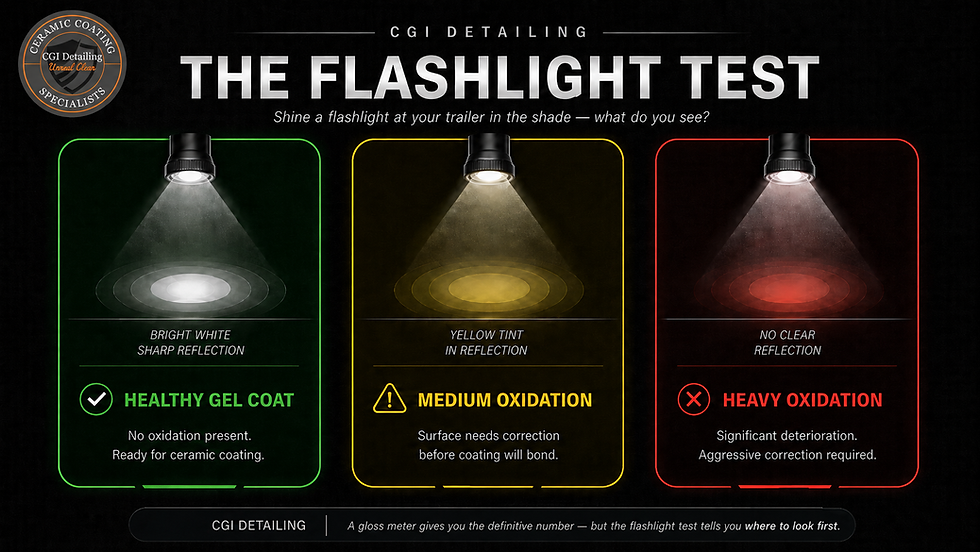
Find a bright flashlight — your phone flashlight works — and take it out to your trailer at dusk or in the shade. Shine it at the side panel and look at the reflection.
A bright, sharp white reflection means your gel coat is in good shape. The surface is still reflecting light cleanly, which means the pores are largely intact and oxidation is minimal or not yet present. A yellow tint in that reflection is the first real warning sign — that's medium oxidation, and the surface needs correction before any coating will bond properly. And if there's essentially no reflection at all — the surface just brightens where the light hits without giving back a clear image — that's heavy oxidation. The gel coat has deteriorated significantly.
This isn't a perfect measurement tool, but it's a fast and honest look at where you stand before you make any decisions.
The Gloss Meter Scale (What the Numbers Actually Mean)
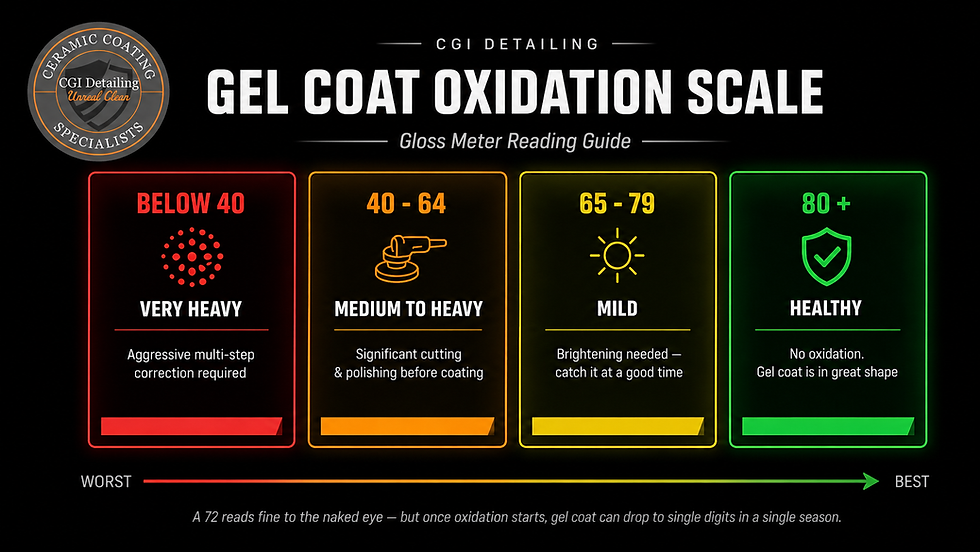
We take gloss meter readings on every single trailer we see. The gloss meter measures surface reflectivity and gives you an objective number. It removes the guesswork entirely.
Here's how to read it: a score of 80 or above means no oxidation — your gel coat is healthy. Between 65 and 79 is mild, early deterioration; the surface needs brightening but you caught it at a good time. Between 40 and 64 is medium to heavy oxidation — the lower you fall in that range, the more aggressive the correction required before coating can even start. Below 40 is very heavy oxidation territory. We're talking aggressive multi-step correction that adds significant time to the job.
A 72 looks fine to the naked eye. Most people with a 72 reading have no idea anything is wrong. But here's what catches people off guard: once oxidation starts, gel coat deteriorates dramatically faster than most people expect. A 72 left unprotected for another season isn't a 50 — it could easily drop to single digits. We've seen trailers go from barely noticeable dullness to complete surface failure in less than a year, especially in southern climates. That's how fast this moves once it gets going.
Why Wax Won't Fix a Chalky Trailer (And What Actually Does)
If you've been waxing your trailer regularly and thought that was keeping the oxidation at bay, this part is important. Wax does not bond to gel coat. It sits on top of it. And on a porous surface like fiberglass gel coat, wax breaks down and disappears in roughly one to three months — and that range depends heavily on your climate. In the Northeast or other cooler climates where you're getting real winters and limited sun exposure for part of the year, wax can hold on toward the longer end of that window. But in Texas or South Florida, surface temperatures on a trailer sitting in direct sun regularly exceed 180°F — which is the actual melting point of carnauba wax. It doesn't just wash off. It literally runs off the surface. A hot afternoon followed by a rain shower and whatever protection you had is already gone.
More to the point: once oxidation has started, wax cannot reverse it. It can temporarily mask very early-stage dullness, but it does nothing to stop the UV penetration or restore the degraded material underneath.
The right solution has two steps. First, remove the oxidation through buffing and polishing — this is the correction stage, and how intensive it is depends entirely on your gloss meter reading. Second, protect the restored surface with a coating that actually bonds to gel coat. We use GlideCoat ceramic coating, formulated specifically for gel coat and marine surfaces and tested in South Florida under some of the harshest UV conditions in the country. It chemically bonds into the porous surface rather than just sitting on top — which is exactly why it holds up for two years where wax disappears in weeks. Automotive ceramic coatings, by comparison, are designed for nonporous clear coat — put one on gel coat and you're looking at a year to eighteen months of real performance at best.
What Happens When Fiberglass Oxidation Goes Untreated
We'll give it to you straight. Gel coat oxidation is not the kind of thing that plateaus. It gets worse, consistently, and the longer you wait, the more it costs to fix.
A trailer reading 70 on the gloss meter still needs a real medium correction — a proper polish to bring the surface back to better than brand new before coating. Left unprotected, that same trailer doesn't slowly drift lower. It falls off a cliff. We've pulled readings in the single digits on trailers that looked reasonable just eight months earlier. At that point we're into aggressive multi-step correction before coating can even start.
Why Two Trailers with the Same Gloss Meter Reading Aren't the Same Job
This is something most people don't realize, and it matters a lot when you're trying to understand what's actually possible for your trailer.
Two trailers can both read a 3 on the gloss meter and require completely different work. A six-year-old trailer at single digits has oxidation that hasn't had time to penetrate deeply into the gel coat. It's severe on the surface, but there's still healthy material underneath — and that trailer has a real shot at being restored to like-new condition. A fifteen-year-old trailer at those same single digits has had years of UV working its way deeper and deeper into the surface. There's less healthy gel coat left underneath, the correction is harder, and the finished result isn't going to be the same. Same number on the meter. Very different trailer.
The older the gel coat, and the less it was maintained, the harder it is to restore — and the less the final result is going to look like new. That's just the reality of the material. Well-maintained gel coat can last twenty to thirty years or more. Neglected gel coat doesn't have the same runway.
When Polishing Isn't the Answer Anymore
There is a point beyond which gel coat cannot be brought back through polishing alone. Trailers fifteen to twenty years old or older, with years of heavy neglect — by that point, the oxidation has gone so deep that no amount of cutting and polishing is going to restore the surface to where it should be. For trailers in that situation, repainting or re-gel coating becomes the more honest conversation. That's a completely different service from what we do — we don't paint or re-gel coat — but it's the right answer when polishing isn't going to get the job done. Retro Renos is a shop we trust that handles trailer repainting and restoration work.
The owners who act early pay the least and get the best result. It's that simple.
Ready to Know Exactly Where Your Trailer Stands?
If you're not sure how bad your oxidation is, that's exactly what we're here for. Every trailer we quote gets a gloss meter reading — you'll know your exact number and exactly what it means before you make any decisions. No guessing, no pressure.
We travel nationwide, so wherever you and your trailer are, there's a good chance we can get to you. Check our travel schedule to see when we'll be near you, or get a free quote and we'll figure out the best way to make it work.
Already coated and want to keep it that way? Our Ceramic Shield Maintenance Plan handles an annual recoating for you so you never have to think about maintenance again.


Comments